


How Decision Analysis Clarified a Major Life Choice
Learning decision analysis in graduate school at Stanford University fundamentally changed my life. When I praise the practice’s virtues, people sometimes ask whether decision analysis can be used for personal life decisions. I always respond with an unequivocal “yes!” My examples typically refer to my “no regrets life.” Yet, I have never detailed a decision analysis process in support of a personal decision outside the classroom.
So when a friend introduced me to a young man wrestling with a pivotal life decision in 2025, I recognized an opportunity to demonstrate the power of decision analysis in service of critical life decisions. Much to my excitement, the young man (named Lawrence here for anonymity) was up for the challenge. He brought patience and diligence to four sessions totaling almost eight hours. The work was fruitful for both of us. Lawrence gained fresh insight into his decision and renewed confidence in moving forward without regrets. I refined and affirmed a method and set of principles for doing this work. Lawrence’s testimonial is particularly gratifying:
“I worked with Dr. Ahanotu when I was approaching a fork-in-the-road moment in life. As I have historically struggled with decision fatigue, we took a numerical and research-focused approach to evaluate the options ahead of me and determine which paths forward were the best for me. This work truly enabled me to not only be more holistic in my evaluation, but also to be more introspective about my values and how my actions can potentially match up to these values. By the end of this experience, I attained a better sense of what my best next steps were, and I truly thank Dr. Ahanotu for his guidance in this endeavor.”
Lawrence’s experience provides a useful case study in how decision analysis can bring structure to a deeply personal choice. This case also illustrates the kind of structured decision support I provide to people facing consequential choices.
Context
I began our first session by establishing the scope and boundaries of the engagement. My role was to structure the decision, challenge incomplete assumptions, expand the available alternatives, and help Lawrence understand how his values directed him toward a quality choice.
I could not serve in a therapeutic or spiritual role. I would apply my expertise in decision analysis while leaving the ultimate choice with Lawrence. His capacity for introspection and commitment to the process provided the candid inputs the work required.
This context set up our methodical implementation of the Decision Chain.
The Decision Chain
The Decision Chain encompasses the six elements of a quality decision. The chain metaphor signifies that a decision is no stronger than the weakest element, or link. These elements are creative alternatives, useful information, sound reasoning, commitment to follow through, helpful frame, and clear values.
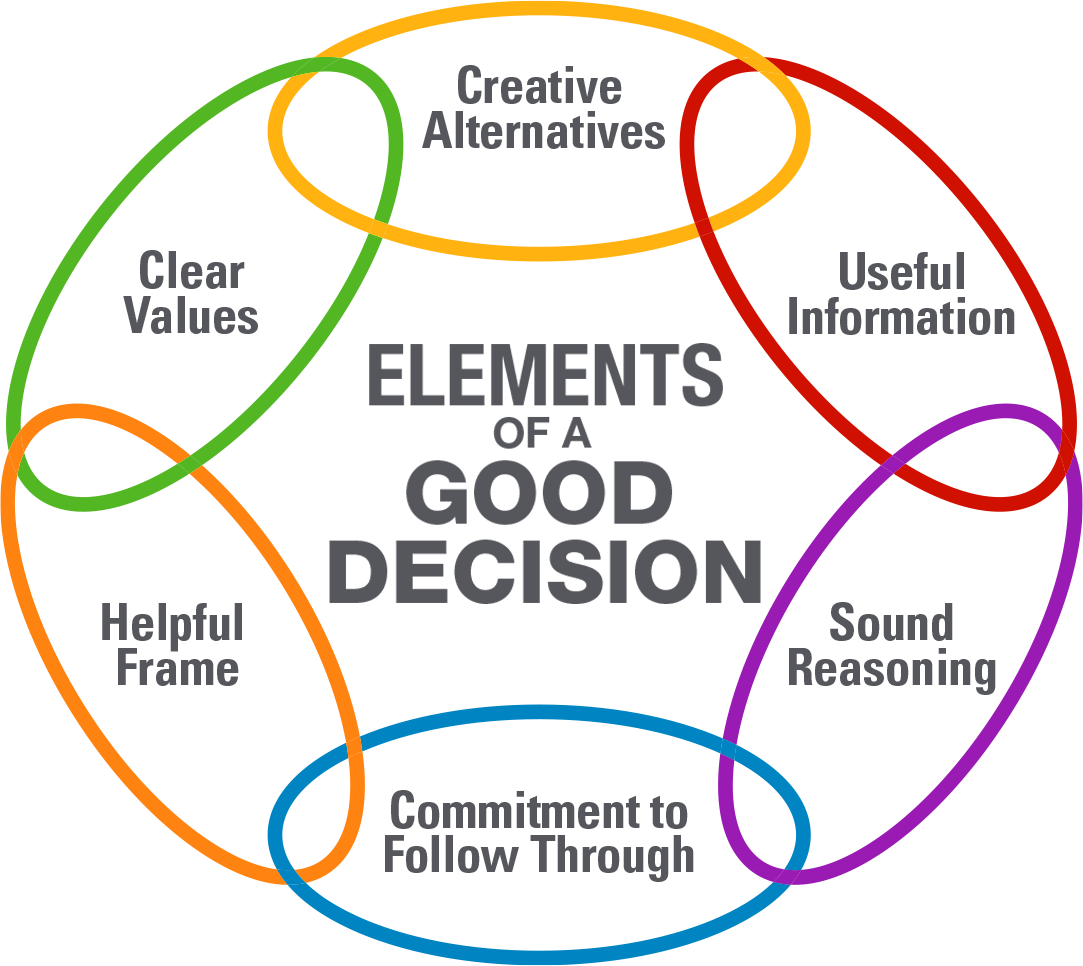
Outcomes do not determine the quality of a decision. A quality decision is well-framed, grounded in the decision-maker’s values, informed by meaningful alternatives and useful information, supported by sound reasoning, and backed by a commitment to follow through.
Helpful Frame
I anchored the process by clarifying the decision at hand with a helpful frame. The components of a helpful frame are purpose, perspective, and scope.
Lawrence’s purpose came from a deep desire to make a significant contribution in his domain of interest. Mentally, I made room for the possibility that our decision analysis could uncover a new purpose (the purpose remained unchanged throughout this process).
In the Decision Chain, the perspective explores multiple ways to approach the decision. I asked questions to clarify the importance of this decision for Lawrence’s life. Lawrence approached this decision through the lenses of achievement and contentment. Given the overlap inherent in these concepts, we took time to untangle their meanings for him.
Lawrence defines achievement as all the conventional trappings of success: money, position, and recognition. His contentment depends on the scope of his impact in his chosen domain. The tension between achievement and contentment provided criteria for evaluating the alternatives.
To clarify the trade-off, Lawrence considered two hypothetical extremes. Achievement without contentment could feel rewarding to him in the short term, particularly when recognized by people whose opinions he valued. But he expected that satisfaction to fade without a corresponding sense of meaningful impact. Moreover, a life with no contentment is a boring life.
On the other hand, a life that provided contentment without conventional achievement would offer internally grounded pride but would require deprioritizing the importance of the thoughts and opinions of others.
For future reference, I noted that the immediate family and trusted mentors would prove critical to Lawrence’s ability to implement a quality decision.
This helpful frame set the stage for Lawrence’s decision. To create the impact he wanted in his chosen domain, Lawrence was deciding whether to attend business school or build a startup. We could value and choose among alternatives by understanding how outcomes scored across the dimensions of achievement and contentment.
Creative Alternatives
Lawrence started this process with just two alternatives for his decision: business school or a startup. However, creative alternatives increase the number of viable paths and can reveal previously unappreciated benefits, costs, and risks. Thus, in this part of the discussion, I pressed Lawrence to consider any and all potential (and realistic) life paths. He brainstormed the following alternatives to add to business school or a startup:
- Join an existing company.
- Earn a master’s degree in a field directly related to his chosen domain (not business school).
- Become a social media influencer in his chosen domain.
- Obtain a government role that would allow him to advocate within the domain, potentially through policymaking.
With a broad set of alternatives, we could proceed with a well-informed exploration of how Lawrence could obtain achievement and contentment. For brevity, I focus here on the considerations for business school and a startup as independent choices.
Lawrence described business school as the “safe” path to achievement. Business school would help Lawrence expand his professional network, give him business-specific expertise, provide access to a broad set of industries, and earn him a valuable brand and market signal. Yet school would take time away from directly learning about his chosen domain.
Building a startup would accelerate his acquisition of practical domain knowledge. A startup would get him right to work making an impact and help him experience personal contentment. The startup path was particularly attractive because he already had ideas for products and services. However, a startup comes with a high risk of failure and an accompanying high potential for diminishing his sense of achievement.
We also explored the timing and sequencing of these alternatives. While Lawrence felt business school had to happen within a specific near-term window, a startup offered a longer horizon given it would address a deeply entrenched problem likely to linger for quite some time. Moreover, business school could improve the odds of success for the startup. We settled on evaluating business school and a startup as immediate and distinct alternatives; we could add temporal complexities as another exercise if needed. The other creative alternatives were also crafted as immediate and distinct alternatives.
Lawrence’s values helped us to prioritize these alternatives so that they would produce a quality decision.
Clear Values
Clear values clarify trade-offs.
As I mentioned earlier, Lawrence wrestled with how to obtain achievement and contentment. These objectives reflected his values. While achievement is externally directed, contentment was internally defined. As Lawrence put it, “I am the only person who has to live with myself.”
Lawrence’s values became more explicit through the quantification process.
Useful Information (Quantification)
The useful information element of the decision chain translated Lawrence’s judgments into a quantitative model. Quantification is not required for decision-making, but, when available, quantification can improve alignment between a person’s values and a decision. This stage can cause discomfort for people unaccustomed to slowing down and quantifying a decision. However subjective, the numbers make personal judgments visible, comparable, and open to examination. I reassured Lawrence that he could use approximations. If we needed to assess close calls, we could test ranges of numbers as part of a sensitivity analysis and thus stress test the resulting decision.
First, I asked Lawrence to weight his objectives and score each alternative against these objectives.
As shown in the table below, Lawrence considered achievement 50% more important than contentment. That estimate produced a 0.60 weight for achievement and 0.40 weight for contentment. The weights were normalized to sum to 1. Next, Lawrence estimated a score on a scale from 0 to 10 measuring how much achievement and contentment each creative alternative would generate for him. Multiplying the score by the weight generated a priority-adjusted score. The last row in the table below sums the weighted scores to calculate a total value for each alternative. For example, joining an existing company produces a weighted score of 6.2 = (0.60 * 7) + (0.40 * 5). A grid like this one can reveal distinctive rankings. In Lawrence’s case, the startup ranked first by a wide margin.
| Objectives | Weight | Join Existing Company | Master’s | Social media influencer | Government Position | MBA | Startup |
| Achievement | .60 | 7 | 3.5 | 7 | 2 | 9 | 10 |
| Contentment | .40 | 5 | 3 | 8 | 8 | 1 | 9 |
| Total weighted score by alternative | 1.0 | 6.2 | 3.3 | 7.4 | 4.4 | 5.8 | 9.6 |
Alternatives come with different costs and likelihood of success.
We codified cost with a simple high, medium, low rating (H/M/L). To keep the analysis practical, we treated the alternatives as immediate choices and retained cost and timing as qualitative considerations rather than additional numerical variables.
A separate table quantifies the likelihood that a particular alternative will generate achievement or contentment. We treated these attributes as independent of each other for ease of estimation. For example, Lawrence estimated that joining an existing company would come at a medium cost (the effort of finding the right fit) while having a 20% (0.20) chance of delivering achievement and a 20% chance of delivering contentment. To simplify the model, we did not incorporate a time horizon.
| Attributes | Join Existing Company | Master’s | Social Media Influencer | Government Position | MBA | Startup |
| Cost of attainment (H/M/L) | M | H | L/M | H | H | H |
| Likelihood of achievement (range is OK, 0-100%) | .20 | .20 | .70 | .10 | .90 | .60 |
| Likelihood of contentment (range is OK, 0-100%) | .20 | .20 | .60 | .10 | .70 | .70 |
The value score measures how rewarding an outcome would be if the alternative delivered it. The likelihood estimates the chance that the alternative will actually deliver that outcome.
With explicit preferences, scores, attributes, and likelihoods, Lawrence and I could reason our way through to a decision.
Sound Reasoning
Sound reasoning brought the frame, alternatives, values, and information together in a structured comparison of Lawrence’s choices. Without these elements, sound reasoning becomes abstract and too hypothetical. The decision tree is a classic tool for sound reasoning, but in this work I represent the tree in tabular form (see Decision Education Foundation for more information on decision trees used in sound reasoning). I call the representative table a “weighted decision model” in reference to the way a decision tree operates.
The decision tree evaluates alternative paths. The tree expresses the odds of achieving various outcomes along each path. Each outcome receives a value and a likelihood, which are multiplied to calculate weighted values. These weighted values are called expected values.
The table below for the weighted decision model uses the weights, values, and likelihoods from the useful information element to calculate the expected value. For example, recall that Lawrence prioritized achievement versus contentment with weights of 0.6 and 0.4, respectively. Lawrence also estimated a 20% likelihood of achievement by joining an existing company. Assuming that joining an existing company provides an achievement value of 7, Lawrence would gain a weighted expected value of achievement of 0.84 (equal to 0.6 * 7 * .20). A similar calculation for contentment from joining an existing company yields a weighted expected value of contentment of 0.40. Adding the two weighted expected values gives 1.24 (equal to 0.84 plus 0.40).
Repeating this exercise across all alternatives revealed that launching a startup ranked highest with a total expected value of 6.12. Getting an MBA and being a social media influencer are a distant second and third at 5.14 and 4.86 respectively. The remaining alternatives scored substantially lower for Lawrence.
| Objectives | Weight | Join Existing Company | Master’s | Social Media Influencer | Government Position | MBA | Startup |
| Achievement Value | .60 | 7 | 3.5 | 7 | 2 | 9 | 10 |
| Likelihood of achievement | .20 | .20 | .70 | .10 | .90 | .60 | |
| Weighted expected value of achievement | .84 | .42 | 2.94 | .12 | 4.86 | 3.60 | |
| Contentment Value | .40 | 5 | 3 | 8 | 8 | 1 | 9 |
| Likelihood of contentment | .20 | .20 | .60 | .10 | .70 | .70 | |
| Weighted expected value of contentment | .40 | .24 | 1.92 | .32 | .28 | 2.52 | |
| Total Expected Value | 1.24 | 0.66 | 4.86 | 0.44 | 5.14 | 6.12 |
The total expected value provides a common and shared scale across alternatives. These values allow for “apples to apples” comparisons even when alternatives are otherwise difficult to compare directly.
Whether calculating relative value by ranking or percentage difference between expected values, choosing the startup stands out as the winner based on this decision tree and its values. Lawrence agreed that doing the startup made sense and aligned well with his values. The startup maintained a sufficient lead that Lawrence felt comfortable proceeding without testing additional scenarios. Choosing the startup alternative was his quality decision. The final question was whether and when he would act on the decision.
Commitment to Follow Through
I made two checks on Lawrence’s commitment to follow through. The first check occurred at the very beginning of the process. I wanted to confirm that the time we invested in the decision analysis would be time well spent. The second check came at the end of the process to serve as a review of all our work together. Lawrence indicated his comfort and satisfaction with the results and recognized that implementation remained his responsibility.
As his next implementation step, I asked him to review the decision with his immediate family and trusted mentors, the people whose views mattered most to him. If we truly constructed a quality decision, these people would either reinforce his commitment or help him recalibrate the analysis before committing.
Conclusion
Almost two months after our last session, I followed up with Lawrence on his decision-making process. I wanted to assess whether his assumptions, circumstances, or conclusions had changed. Lawrence still felt compelled to pursue the startup. Here is what he had to say (anonymized):
“I took some time to think about the outcome of our work…I’ve decided that I’m going to really lean into the startup. Absolute worst-case scenario, I spent months on something that didn’t pick up, but I learned how to use AI tools, I spoke with potential users/ customers, and I built a product that I think helps them. Better case, the product is positive for others and picks up!
Re: business school…Where I’ve landed on this so far is that I am going to pursue other avenues outside of business school for now. If something drastically changes in the future, I’ll reconsider. But I’m not seeing the glitz and glam of doing business school right now. Is not doing b-school riskier? Yes. But I think that’s all the more reason to go for it. Worst case, b-school will be there in 3-5 years.”
Lawrence’s review revealed additional benefits of the startup that we did not capture in the original analysis. Lawrence also realized that business school in the short term was even less attractive than his original estimate. For the initial comparison, we treated the alternatives as immediate and distinct choices. This kept the model practical. Lawrence’s later reflection revealed an additional advantage: pursuing the startup first preserved business school as a future option, even though it appeared relatively unattractive in the current context.
Lawrence’s experience demonstrates the practical value of decision analysis for consequential personal choices. By making his values, alternatives, assumptions, and trade-offs explicit, the process transformed subjective judgments into a structured basis for choosing with greater clarity, confidence, and ownership.
If you are facing an important personal or professional decision, I offer the same structured decision-analysis process designed to help you understand the choice, evaluate the alternatives, and move forward without surrendering ownership of the decision. Contact me to discuss how decision analysis can help.