


The Insights Supply Chain as the Operating Model for Advancing Data Maturity
Why data maturity needs an operating model
Data maturity does not improve through tools, dashboards, or isolated and disconnected investments. It improves through an operating model. In the context of data maturity, an operating model defines how data flows, how decisions are made, how roles are coordinated, and how outcomes are produced. The Data Maturity Curve describes the data-related changes in a progressing organization: more reliable data, better tools, broader access, and greater confidence in decision-making. However, the Data Maturity Curve does not explain how to achieve that progression. In practice, this gap is where data initiatives can stall. The Insights Supply Chain (ISC) addresses this gap by providing an operating model that orchestrates data, workflows, and decision-making across the organization.
A holistic process uses the ISC as an operating model for data maturity: a method for orchestrating data engineering, data analytics, and insights analytics so that an organization can effectively measure context and choose how to operate accordingly. Without this kind of operating model, improvements in tools, data, or talent tend to remain fragmented and fail to translate into consistent decision-making. (Insights analytics directly connects analytics to organizational decision-making; see “Beyond Business Intelligence: The Insights Supply Chain as a Better Framework for Data Teams” to explore the different terms used for the roles on data teams.)
The ISC overlays a critical imperative: data maturity must be well-balanced across the organization. Without the balance, failures in one part of the chain propagate to others, limiting the organization’s ability to produce reliable decisions. For example, fragmented analytics maturity creates systemic failure: strong visualizations collapse under weak data engineering, eroding trust in the entire system. As another example, an organization may generate innovative analytics models that rarely make it to production because they do not answer questions or solve problems relevant to the business. The ISC is only as strong as its weakest point. Much like the Decision Quality Chain, an organization produces decisions as robust as the weakest link in the chain.
With this operating model in place, data maturity becomes easier to structure and scale. The ISC and the Data Maturity Curve then work together as three pillars:
- Data Maturity Curve: defines the progression of capability (what improves).
- Insights Supply Chain: defines the mechanism of improvement (how it improves).
- Data Org Matrix (DOM): defines organizational alignment (who enables the improvement).
The Data Maturity curve has several functional definitions. For its explanatory directness, I am using the crisp definition from product analytics platform company Heap in “How to achieve data maturity and grow your business“: it “boils down to how well a company leverages data for decision-making”. For example, the least data mature companies act in ad-hoc fashion, whipped around by the strongest opinions. The most data mature companies lead with evidence-based insights.
The Data Maturity Curve has a standardized trajectory but depictions of the stages (or levels) can carry different emphases. For this discussion, I use a 4-stage model that blends descriptions and definitions from Heap’s Operational Maturity Model, Bonterra’s Impact Management Model, and the IDC Maturity Spectrum.
| Emphasis | Stage 1 | Stage 2 | Stage 3 | Stage 4 |
|---|---|---|---|---|
| Operational Maturity | data exploring | data informed | data driven | data transformed |
| Impact Management | committed | counting outputs | measuring outcomes | managing outcomes |
| Maturity Spectrum | lagging | progressing | advancing | leaders |
Graduating through the phases is key for an organization’s effectiveness. According to “How Data Maturity and Product Analytics Improve Digital Experiences and Business Outcomes” by David Wallace Research Director, Customer Intelligence and Analytics, IDC (2022) leaders outperform laggards by an average of 2.5x across measures of revenue, shorter time to market for new products and services, customer satisfaction/loyalty (NPS), profit, improved operational efficiency, and employee productivity.
Stage 1: Fragile and uneven capabilities
Core maturity pattern: Data exists, but it is not operationalized. Tools and processes are inconsistent; governance is unclear; teams default to intuition or habit.
At Stage 1, organizations first recognize the need to collect data and commit to doing something. However, at this lagging stage of maturity, they lack standardized best practices and policies for management and access. Different teams may use a variety of non-standardized data sources, with different definitions for the same metrics. Using multiple analytics tools reinforces data conflicts and inflates IT budgets. Given this data chaos, the loudest and most insistent opinions typically carry the day. The organization spends a lot of time exploring data but cannot reliably use these data to answer questions quickly or consistently.
Organizations fail to operationalize the ISC due to the absence of data strategy and coordination. Here are some examples for recognizing Stage 1 maturity in the ISC:
- Data engineering: ad hoc pipelines; manual extracts; inconsistent definitions; brittle instrumentation.
- Data analytics: reporting focuses on activity counts and “what happened,” often with a high volume of rework.
- Insights analytics: insights are sporadic, hard to reproduce, and difficult to translate into decisions.
Also at this stage, the DOM only exists by accident. Data professionals skew toward decentralized generalists who do not yet have the skills and/or resources to build a bridge to the next stage of data maturity. Collaborations are mainly personality driven and not based on systematic strategies.
Organizations move to the next stage by addressing three requirements that begin to operationalize the ISC:
- Define the minimum viable semantic layer: metric definitions and ownership.
- Create basic governance guardrails: who can change definitions, where they are documented.
- Stabilize the upstream flow: instrumentation, collection, and repeatability (upstream failures create mistrust downstream).
Stage 2: Early Formalization of Tools and Process
Core maturity pattern: Leadership invests; processes become repeatable; teams begin to establish basic best practices; success metrics are normalized.
Heap explains that at Stage 2 leadership begins investing in analytics tools and the data stack, filling gaps, prioritizing collection and management, establishing best practices for planning and post-launch analysis, and the inclusion of success metrics. The commitments at the end of Stage 1 focus leadership and their teams on a functional semantic layer, basic data governance, and a stable flow of data. While the organization’s data maturity is mostly limited to reporting on outputs and outcomes, at least more and more people feel data informed. For example, Wallace notes a dramatic progression from lagging teams to leader organizations: “Seventy-six percent of leader organizations have a single source of truth, compared with 3% of lagging organizations. And 82% of leader organizations have a centralized data dictionary, compared with 2% of lagging organizations.”
At this stage, the ISC takes shape as leadership actively thinks about how to improve organizing around data. However, this feeling of progress from being data informed can also generate an inflated sense of maturity as data accumulates and dashboards proliferate without an operating model.
An imbalanced ISC moves at different speeds:
- Data engineering improves enough to reduce some bottlenecks, mostly by the urging and pushing of newly empowered data analysts. Basic governance increases organizational confidence in data reliability and stability.
- Data analytics accelerates as the most visible champions of using data. Tools help analysts deliver faster. Agreements on data semantics increase confidence in analyses.
- Insights analytics appears but operates inconsistently as business stakeholders adjust to data availability and data analysts scramble to prioritize their time between technical and business work.
Heap points out that cultural norms are not yet established enough to generate the feedback loops. This feedback will eventually improve the different stops along the ISC.
Decentralized execution may still dominate the DOM. However, better data and better tools open up possibilities to improved collaboration which in turn facilitates questioning of the existing organizational structure. Organizations must reconcile conflicting metric definitions and resolve redundant data sources. These efforts also drive reconsideration of organizing principles.
Heap describes the bridge to the next stage as data analysts evolving from “more reporting” to “faster answers.” The proliferation of dashboards and accumulation of data can slow down answer generation with conflicting narratives and attention drawn to the wrong priorities. Faster answers emerge as organizations align on success metrics and reinforce shared definitions. These steps strengthen coordination across the ISC.
The acceleration in analytics from laggards to leaders can be dramatic. According to Wallace, only 37% of lagging data teams can generate answers in a day or less. Leading data teams take at most a day to deliver answers 97% of the time.
Finally, in Stage 2, business stakeholders increasingly gain clarity on how best to work with the data staff. This clarity enables strategic decision-making.
Stage 3: Strategic ISC Choices
Core maturity pattern: Data access is democratized; data is embedded in culture; experiments shape changes; goals are outcome-oriented and explicitly tied to business impact, AI-based implementations make sense.
Stage 3 requires leaders to make explicit trade-offs between speed and control, centralization and flexibility, and specialization and scalability. At this point, everyone in the organization fully appreciates the stakes and actively participates in the work of climbing the data maturity curve. Once in Stage 3, work focuses on measured outcomes. Organizations make explicit connections from data collection to data organization to analysis, and ultimately to business impact from data-driven decision making. Data leaders and team members now recognize that:
- Competing metric definitions create operational risk.
- Data quality failures cause business failures.
- Advancing maturity includes pushing data responsibilities and capabilities upstream in the ISC through AI-driven orchestration.
As clarity improves, leaders make explicit choices about: 1) specialization vs generalization, and 2) centralization vs. decentralization. Leaders choose with guidance from the ISC.
The company can also confidently decide that data is a core competency and commit the necessary resources to the correct DOM.
Significantly, implementations of AI solutions increase the flexibility and optionality of the ISC, but they also increase the need for a well-defined operating model to manage scale and complexity. When operating at scale, an AI-driven environment requires moving validation and quality assurance further upstream in the ISC to handle the scale of automated insights.
Key questions under consideration include:
- Where must governance centralize to prevent failures in the data ecosystem, especially for context-hungry AI-supported workflows.
- Where can execution decentralize without fragmenting definitions, stifling needed collaboration, or breaking AI orchestration?
- Which roles must remain specialized given the need for innovation and which roles can be generalized for increasing responsiveness?
Getting to Stage 3 is a significant achievement. Still, advancing through Stage 3 enough to get to Stage 4 requires even more work. Many organizations can remain in Stage 3 for quite some time and produce strong, data-driven outcomes. However, organizations whose success depends on data as a core competence must continue pushing to Stage 4.
Such organizations must strive for the following:
- Codify generators of outcomes. Explicitly connect ISC outputs (models, dashboards, analyses, insights) to business outcomes and make these processes repeatable.
- Decide how to scale governance without becoming a gatekeeper. This is an important element in the era of AI which can distribute capabilities across linkages in the ISC.
- Establish career paths. Motivate data professionals with the promise of career development and upward mobility.
Stage 4: Data As A Core Competence
Core maturity pattern: Data becomes a strategic asset. Data professionals throughout the organization participate in a community of practice that shares best practices, provides upskilling, maintains pace with innovations in data, and cultivates formal knowledge management. Wherever needed and relevant, the organization establishes standardized metrics, shared truth, predictive capabilities, and continuous improvement along the entire ISC. AI capabilities are intentionally developed and well-integrated into the data ecosystem.
In Stage 4, data leaders hold prominent positions in the organization and champion their teams and their growth. These leaders instill confidence and progress by:
- Emphasizing the transformation of data into actionable insights aligned with strategic objectives.
- Managing outcomes with the consistent use of systematic and established data processes.
- Demonstrating clear paths for data professionals to become leaders on their teams and/or in their domains.
- Rewarding and incentivizing high standards for data quality, analytic acumen, and collaboration whether within centralized teams or across decentralized teams.
In Stage 4, continuous improvement becomes a consistent dynamic driving the ISC. Specifically:
- Data engineering becomes a reliability discipline that sets the foundation of data quality with comprehensive monitoring and evaluation. Robust semantic models permeate the data ecosystem.
- Data analytics “productizes” its work with a focus on automated services that free up time for collaboration, participation in strategic initiatives, and architectural improvements. Data analysts fully mature as curators, communicators, and product thinkers.
- Insights analytics owns accountability for the effectiveness of data-driven decision making with feedback loops throughout the ISC.
At this final stage of data maturity, data is a core competence that will tend to push organization to choose specialization over generalization. AI-enabled tools bridge specialties where generalization helps data professionals respond faster to that growing data needs of the organization. For more details on this process, see “How to Orchestrate AI Roles in the Insights Supply Chain.” The following summary comes from that explainer:
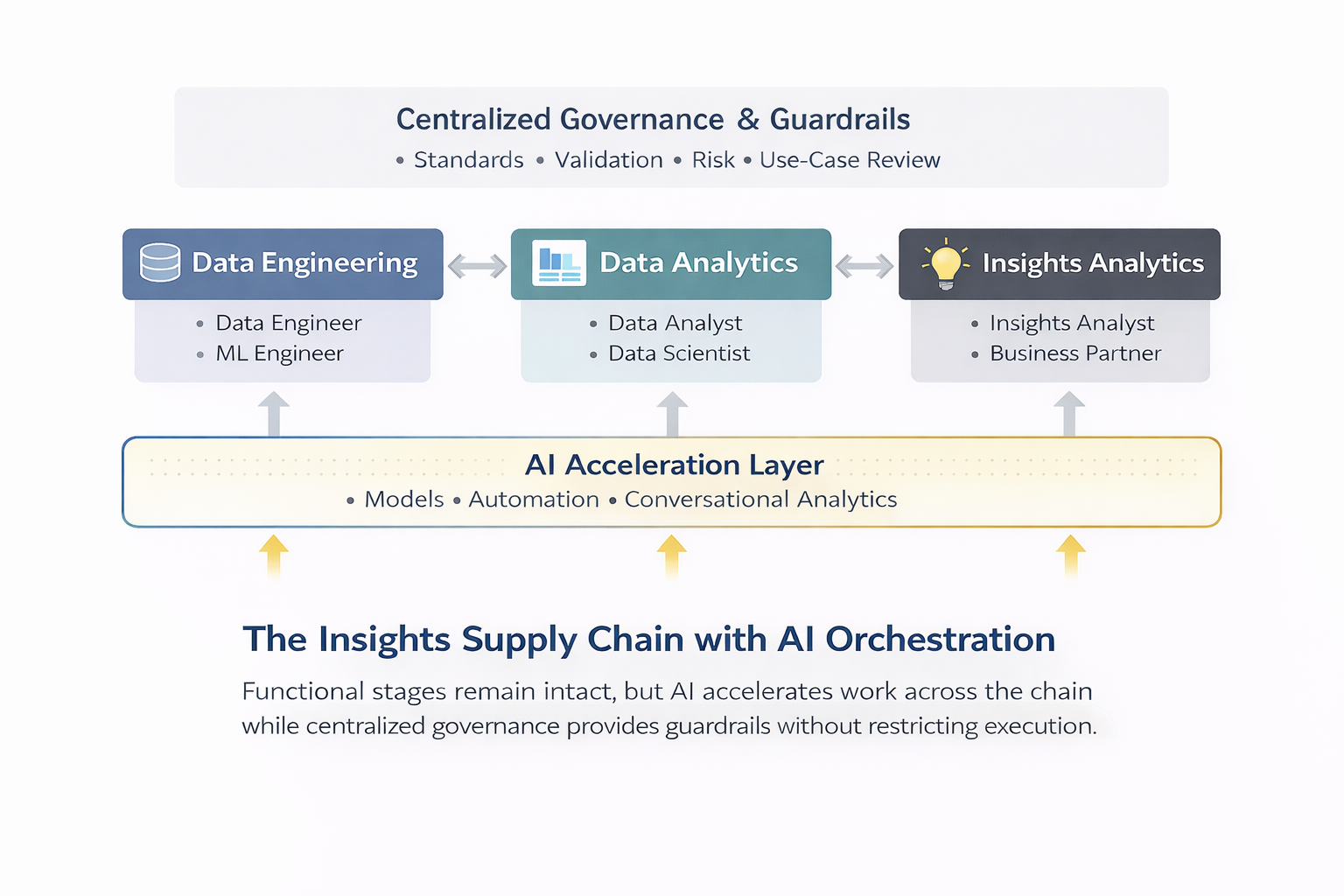
What ongoing progress looks like in the Insights Supply Chain:
- Institutionalize shared semantics and shared truth as a durable foundation for speed and continuous improvement.
- Automate validation and reduce the odds of acting on brittle assumptions.
- Design data democratization and AI-supported solutions as systems for expanding and/or deepening the capabilities and reach of data professionals within the ISC.
Conclusion
Most organizations generate, own, and cultivate large volumes of data. Today’s value-creation model lives across multiple dimensions. Data maturity is the “why,” the Insights Supply Chain is the “how,” and the Data Org Matrix is the “where.”
The integration can be summarized as follows:
- Data maturity stages define requirements for decision-making capability including speed, reliability, experimentation norms, and confidence.
- The ISC defines how to build maturing data capabilities and identifies how failures and success propagate from upstream to downstream and back.
- The DOM informs staffing decisions that support the ISC’s ability to advance data maturity.
This integration demonstrates the importance of solving overlapping orchestration challenges. Data maturity is ultimately achieved through disciplined execution. The Insights Supply Chain provides an operating model that enables organizations to move from questions to answers, from answers to decisions, and from decisions to outcomes.
Need help with your Insights Supply Chain? Contact Ahan Analytics and stay up-to-date with me on Facebook or LinkedIn!