

Finish the Game: How Improbable Comebacks Teach the Wrong Lesson
While sports attention has long since moved on from the NBA Finals to the triumphs and tribulations of the World Cup, I cannot help reflecting back on the narratives heralding the improbable comeback of the New York Knicks in Game 4. The celebration of grit and resilience is common throughout sports and particularly compelling when an eventual champion avoids near-certain defeat. However, the excitement from such glory gets over extended when the comeback is treated like a lesson for daily life. Does it really make sense to bet against the odds all the time? Without updating prior beliefs about the odds of such a comeback, the improbable comeback should serve more as a lesson for the potential victims of such downfalls. Improbable comebacks remind us to FINISH THE GAME.
The Comeback
So what happened?
At halftime, the San Antonio Spurs had roughly a 99% chance of winning after taking a commanding 76-49 lead.
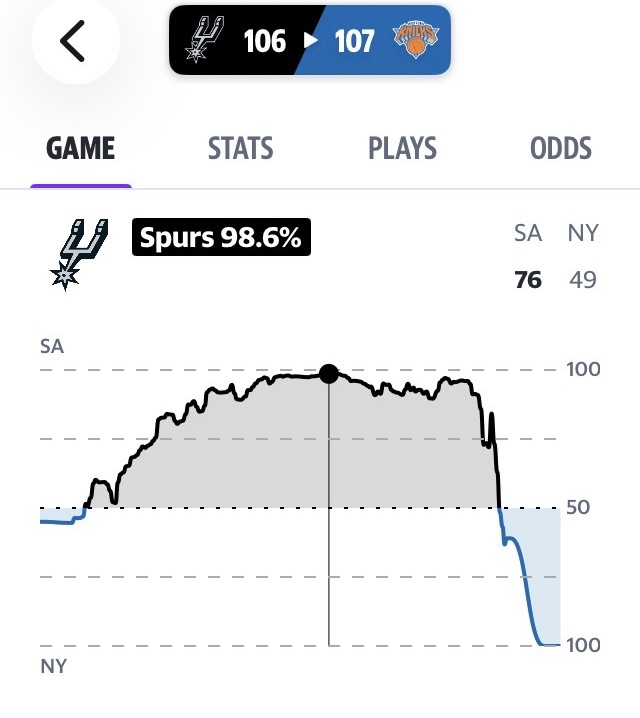
The Knicks steadily eroded the deficit. After the third period, San Antonio led by 15 points. The Knicks won the game by one point in the final seconds. In the video below, ESPN covers the key plays leading to the grand finale. While the Knicks succeeded with a barrage of three-point baskets, the Spurs made critical errors late in the game. Spurs coach Mitch Johnson was forced to keep his star center Victor Wembanyama in the game longer than usual, and Wembanyama’s fatigue in the final minutes contributed to the loss. (Wembanyama played 44 minutes in Game 4, 10% more than his second-highest effort, far surpassing the 40 minutes he played in another one-point loss in Game 2).
Lessons Learned: Whose Destiny Triumphs?
An endearing interview with a young Knicks fan is emblematic of the inspiration people can take from improbable wins. In “Life Lessons Learned from Game 4”, a news reporter asked the kid for lessons learned from the game. The child responded: “What I learned is that when you never give up…something will always good happen…when you put hope to it, anything is possible.” We love to believe that we can will ourselves into outcomes. There is an irresistible allure to believing that we control our destiny no matter how many other people’s beliefs in their destinies must be sacrificed in the process. Just like most competitions, a championship series is a zero-sum game. Every team’s win is another team’s loss.
The San Antonio Spurs believed in their own destiny. For example, even after losing the first two games of the Finals, the Spurs fully believed they could will themselves to an unlikely comeback and win the trophy. Only five teams in NBA Finals history have ever won the Finals after going down two games to none. In an interview after losing Game 2, Wembanyama reflected confidently (emphasis mine): “It felt like we did a lot of things wrong, but we were also relentless and kept pushing, but kind of wasted that effort. I know it’s not wasted because our lessons are learned. I know we’re not going to make the mistakes of the past again. But in a moment like this, we need to make these things matter.” The funny thing about learning lessons in competitions is that learning is available to each and every participant.
The Guardian wrote about lessons learned in its review of Game 4.
“Being on the receiving end of an unlikely comeback teaches you, in unforgettable fashion, that no lead is safe and no game is ever truly over. The scar tissue of past playoff disappointments, the callouses left after having a win ripped out of your fingertips – those can be life’s greatest teachers.”
In other words, a compelling lesson to learn from improbable comebacks is that ultimate victors finish the game. Winners do not assume their opponents have lost belief in their destiny.
Trust the Process
The Guardian presented a refreshingly balanced perspective about Game 4 from Knicks point guard Jalen Brunson.
“I think everybody, to a certain degree, at some point in life is overlooked…Just to have the ability to stay with it, stay with it, stay with it, stay with it, especially when you get knocked down, to me, that defines who you are. Even if you don’t have the quote-unquote ‘ultimate success’ that you think you deserve, if you get knocked down in life and you’re able to get back up and keep fighting, that’s a freaking win.”
Notice Brunson deflected attention away from the desired outcome (the ultimate success) and focused on his own effort, something under his direct control. He trusts the process of working hard so much that the effort alone represents a win. Defeating the opponent is an extra reward and not even the primary reward.
That message about finishing the game and excelling in the process gets lost in celebrations about being the recipient of improbable rewards.
The Spurs Also Lost the Game
Yahoo Sports noted how the Spurs played like a completely different team from the first half to the second half:
“After hitting 14 of 26 3s in the first half, the Spurs shot 3 of 17 (17.6%) in the second to finish the game 17 of 43 (39.5%) from long distance. They shot 41.9% from the field. Their 30-point total for the second half fell short of their 41 points in the first quarter and 35 in the second.”
The collapse of the Spurs was thorough and did not seem to result from changes in the Kicks’ defense.
Look no further than the lamentations from the Texas Monthly to understand that Game 4 was not just about the Knicks winning. Game 4 was also about the implosion of the Spurs. In “An Oral History of the Spurs’ Historic, Horrifying Game-Four Collapse“, the publication documented the emotional roller coaster experienced by Spurs fans during Game 4. Spurs fans did not observe a Knicks team willing itself to a win. Instead, they witnessed a Spurs team defeating itself. Here are some choice quotes:
- The big change in the third quarter was when the Spurs seemed to rely solely on three-pointers. They weren’t taking it to Wemby in the paint, where he had been so aggressive earlier. And the Knicks were hitting shots.
- When Wemby, who shot 82 percent from the line this year, missed those two free throws with a few minutes left, I thought, They’re going to lose this.
- “Fox—the one guy on the team who’s been there before—took off on his fast break, and I thought I was hallucinating. Shot blocked.”
The Spurs were leading by a point with 13 seconds to play when De’Aaron Fox tried to convert a fast break down the court into a layup. In real time, commentators wondered why Fox did not slow up, burn clock, and force the Knicks to foul him. Of all the points in the game where the Spurs took the off-ramp from victory, this last divergence proved to be irreversible.
Finish the Game
While you cannot will yourself to invalidate the “destiny” of an opponent, you can will yourself to do everything in your power to support success. The admonishment to finish the game lives in the time-tested Serenity Prayer:
“God, grant me the serenity to accept the things I cannot change,
Courage to change the things I can,
And wisdom to know the difference.”
If you cannot identify your locus of control, you will happily bet on the improbable far more than you can afford. Knowing the difference between the serenity of acceptance and the courage to act sits at the core of making quality decisions. Decision analysis is the engine that helps you finish the game with no regrets…irrespective of the odds.