

Beyond Business Intelligence: The Insights Supply Chain as a Better Framework for Data Teams
For many years, I have used the Insights Supply Chain to frame my perspective on how organizations transform raw data into insights that support decision-making. This framework prioritizes strategies, processes, and methods without drawing boundaries solely around the roles of the people critical to its functioning. Along the way, I began using the term data professional as a general label for participants in the Insights Supply Chain.
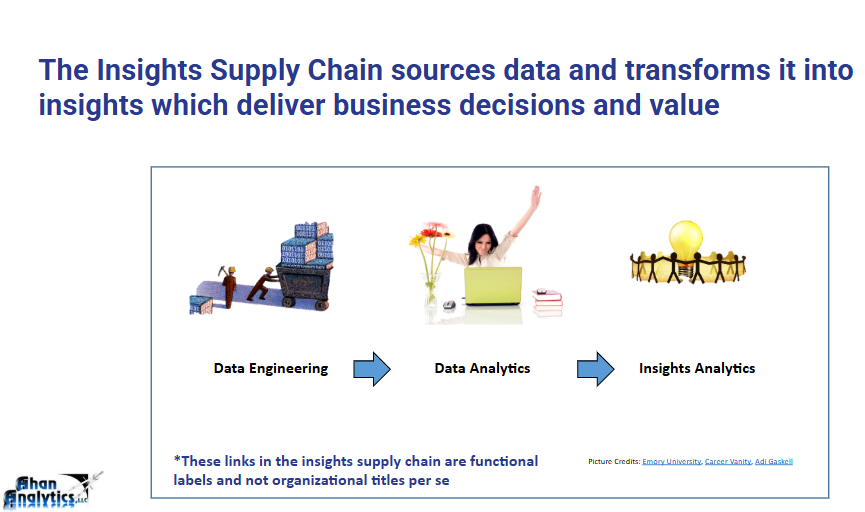
My roots and experience as a Data Analyst have convinced me to give Data Analytics a central place in the functional labels of the Insights Supply Chain with Business Intelligence (BI) subsumed by the Insights Analytics label. A recent interview with the “Godfather of Business Intelligence,” Howard Dresner, prompted me to make a formal case for this viewpoint.
When BI Tries to Be Everything, It Risks Meaning Nothing
A month ago, DataCamp featured Dresner, the Chief Research Officer of Dresner Advisory Services, on its DataFramed podcast. Dresner described BI as an umbrella term defining “fact-based analysis driven by data.” This definition is redundant, even tautological—facts are a form of data, and analysis without data is opinion, typically of little use for an intelligent organization.
Dresner then claimed that “agentic and conversational analytics is part of business intelligence because the intent is to deliver the same capabilities. Generative AI, chatbots all fit the definition.” This broad expansion blurs too many lines and suggests that anything and everything that uses or processes data within an organization is part of BI. Under such a definition, almost anything that makes an organization “smarter” with data becomes BI.
When a definition tries to cover everything, it explains nothing. Today’s complex and specialized data ecosystems demand more precision, not less.
Google’s Answer on Business Intelligence: Bounded Definition, Blurred Boundaries
Google’s career certificate program in Business Intelligence offers a bounded definition in “What Is Business Intelligence?“:
“Automating processes and information channels in order to transform relevant data into actionable insights that are easily available to decision-makers. In other words, by showing decision-makers what is currently happening, organizations become more intelligent and successful.”
Under this definition, tools such as Generative AI, chatbots, agentic AI, and conversational analytics can enhance the work of BI analysts, but they are not themselves Business Intelligence. Just as a whiteboard or presentation slide is not BI just because it helps convey insights, these technologies act as tools and delivery mechanisms, not the BI discipline itself.
Google acknowledges that “both BI and DA [Data Analytics] professionals enable data-driven decision making in their organizations” and that “BI and DA complement and rely on each other,” consistent with the structure of a supply chain for insights. Google’s more detailed attempt to draw distinctions highlights a tool-based focus for BI versus a methodological focus of Data Analytics. BI Analysts build and maintain the analytics tools that deliver visualizations, dashboards, and reports in a standardized and repeatable process, built with readily available and timely data.
The following list summarizes how Google describes the differences in more detail. I added emphasis to highlight the tools focus in the definition for BI:
- Data Analysts achieve higher levels of data maturity by answering questions about what happened.
- To achieve data maturity, BI professionals build data reporting tools such as dashboards.
- Establishing repeatable processes, BI helps organizations understand how things are operating. By knowing the current state, business leaders can take action to improve the future state.
- Focused on near real-time, rapid monitoring, BI delivers insights that are most effective when they make an impact right now.
- Expert tool builders, BI professionals create solutions that Data Analysts apply to answer questions or solve problems by examining data through a specific topic or lens.
- Skilled in data infrastructure, BI professionals also enjoy the technical side of data analytics.
The last two points highlight the overlap in definitions that created blurred boundaries. If a Data Analyst uses BI tools—especially to answer business questions and support decision makers—then the Data Analyst works at the end of the Insights Supply Chain instead of further upstream. If a BI Analyst works on data infrastructure with the technical knowledge of a Data Analyst, then the BI Analyst operates further upstream in the Insights Supply Chain. The distinction between these two roles can depend entirely on the operational context and an organization’s strategic choices (as proposed in the Insights Supply Chain).
In “Data Analytics for Beginners“, Google plainly defines Data Analytics as “the science of data.” Later in the module, with no reference back to Data Analytics, Google defines Data Science as “creating new ways of modeling and understanding the unknown by using raw data”. Google also defines a Data Analyst by the role they play: “Companies hire data analysts to control the waves of data they collect every day, make sense of it, and then draw conclusions or make predictions.” Google continues: “This is the process of turning data into insights, and it’s how analysts help businesses put all their data to good use… turning data into insights.” In the Knowledge Cast podcast, Paco Nathan, Principal DevRel Engineer at Senzing, highlights the overlap between Data Analytics and Data Science by insisting that Data Science is not the “matter of building predictive models”. Instead, “the core of it is investigation, discovery.”
Clearly, Data Analysts can walk and talk just like the archetypal BI Analyst.
Wikipedia Misapplies Microsoft’s Role Framework and Collapses Distinct Roles
I lastly turned to the wisdom of the crowd in Wikipedia but left wanting. (I wrote this blog instead of editing Wikipedia because I am not yet ready for the back and forth in trying to get my epistemology—my theory of how knowledge should be structured in this domain—accepted by the crowd.) Wikipedia does not even have an entry for Data Analytics (volunteers anyone?). Most discouraging to me about Wikipedia’s treatment of Business Intelligence is the rollup of all the roles of data professionals into the Business Intelligence framework. That treatment uses a module called the “roles in data” from Microsoft’s learning series on Data Analytics.
Microsoft states that the key difference between the business analyst and the data analyst is “what they do with data. A business analyst is closer to the business and is a specialist in interpreting the data that comes from the visualization. Often, the roles of data analyst and business analyst could be the responsibility of a single person.” This role for the BI Analyst (the Insights Analyst at the end of the Insights Supply Chain) is quite restrictive compared to the expansive role of the Data Analyst:
“Data analysts are responsible for profiling, cleaning, and transforming data. Their responsibilities also include designing and building scalable and effective semantic models, and enabling and implementing the advanced analytics capabilities into reports for analysis. A data analyst works with the pertinent stakeholders to identify appropriate and necessary data and reporting requirements, and then they are tasked with turning raw data into relevant and meaningful insights.”
That explanation sounds akin to the expectations of a Business Analyst based on Google’s exposition. The lines blur further as Microsoft expands the Data Analyst’s responsibilities directly into the BI tool: “A data analyst is also responsible for the management of Power BI assets, including reports, dashboards, workspaces, and the underlying semantic models that are used in the reports.”
By incorporating this learning module without distinction, Wikipedia reinforces the conflation of Business Intelligence and Data Analytics—undermining the clarity organizations need to build well-structured data teams.
The Insights Supply Chain As An Improved Framework for Data Roles
The Insights Supply Chain avoids the pitfalls of bounded definitions that blur upon closer examination. Instead, it drives strategic and tactical decisions:
- Should data professionals be centralized or decentralized?
- Should responsibilities be specialized or generalized?
In a centralized, specialized team, you may find Data Engineers, Analytics Engineers, Data Analysts, Data Scientists, and BI Analysts working together. In decentralized, generalized teams, one role may combine responsibilities from multiple specialties. For example, in my consulting work, I sometimes perform most of the functions in the Insights Supply Chain. Thus, I maintain a broad and holistic perspective on how data teams function in the larger data ecosystem.
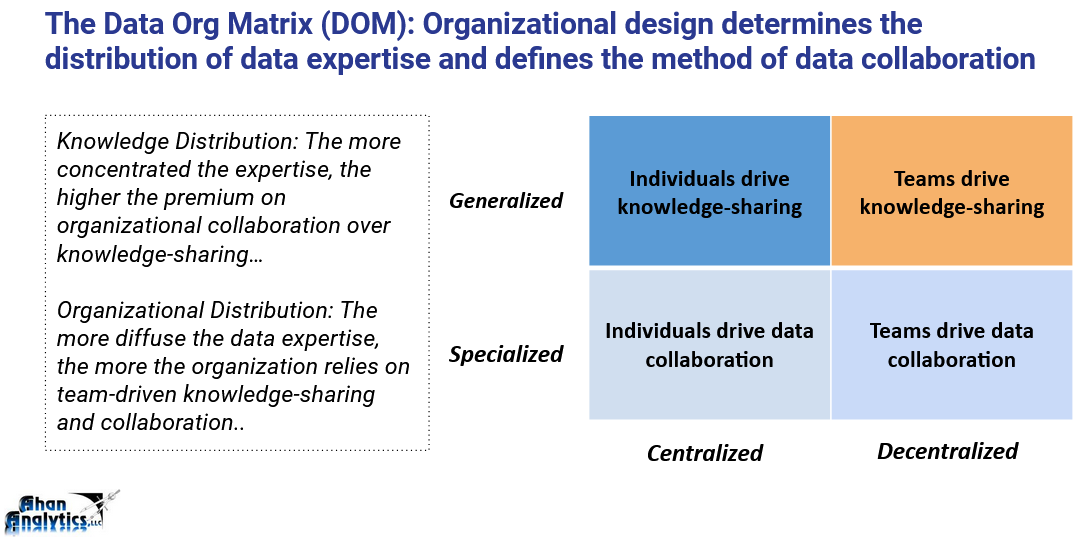
In this framework, titles serve as tools for hiring and career progression, but the organization’s structure and strategy determine the important role definitions and distribution of work.
Precision in Role Design Protects Performance
These distinctions are not pedantic. Without clarity, organizations risk:
- Under-utilizing data professionals
- Creating confusion over responsibilities and authority
- Building data silos
- Producing redundant or conflicting data pipelines
Clear role definitions within the Insights Supply Chain allow data teams to operate efficiently, deliver value faster, and avoid costly inefficiencies. The Insights Supply Chain provides the framework to make these distinctions consistently—ensuring data professionals work where they add the most value.
Need to align your data team for maximum performance? Contact me for an initial consultation.

This is outstanding insight and wisdom Duru! Thank you Kind Sir!!