


Today’s Data Analyst: Curator, Communicator, Product Thinker
Colin Zima, CEO of business intelligence platform company Omni, crystallized for me the allergic reaction I had to Looker’s proposal to offer up Agentic Analytics to solve the problem of insufficient bandwidth for data analysts (see Agentic Analytics Cannot Lead: The Enduring Need for Data Professionals and Analytics Leadership). In an interview on DataFramed June 16, 2025, Zima described the Business Intelligence (BI) Analyst (going forward I will more generally use the term “data analyst”) as a curator, communicator, and product thinker. He focused on the very human process of enabling a business to use data effectively.
Instead of dogged automation, Zima explained how a robust BI tool like Omni supports the human process, not substitutes for humans. Zima also challenged the distinct roles that form the Insights Supply Chain – my organizational concept for data strategy and data teams. Today’s data analyst must develop a broad range of skills to either exercise on their own or to enable collaborations with a wide variety of domain experts: the data engineer, the user experience designer (UX), the project manager, the product manager, and the business practitioner. The cross-functional data analyst has become a systems-level designer of data-driven decision making.
Curator: As Simple As Possible, But Not Simpler
Einstein admonished us to “make everything as simple as possible, but not simpler.” As a curator, the data analyst sits between the complexity of a data model and the complexity of a business. To make the data model work, the data analyst must abstract the business as simple as possible but not so simple that the related data model no longer serves business needs. Similarly, to make data understandable and usable to the business, the data analyst may simplify the data model in the form of a dashboard but not so simple that the business user can only answer a narrow and incomplete set of questions. Curation is the active trade-off between simple but not too simple.
Zima illustrates this curator role when explaining why software platforms continue to struggle to simplify data for non-technical users: “if you come and ask me for customer data, I can hand you a very very clean version of that table that you understand really well and can go work with…in some sense that’s not an Excel thing, that’s not a BI thing, that is a human made you a really small data set that represents a very curated piece of data.” It is the human curator who must navigate that complexity. Tools can simplify, but they must also provide depth—such as a semantic layer—for flexibility when needed.
A data analyst, then, is responsible for making trade-offs: completeness vs. clarity, flexibility vs. usability. That curation work is strategic, not clerical.
Communicator: Navigating Semantics
Curation works through communication. Communication is the tool for collaboration. Zima makes plain the importance of the data analyst’s skills in communication by again ascribing the human function as central in delivering usable data: “…if you want to be perfectly right, you need to understand some of that nuance to do your job well….I often don’t think it’s actually a tools problem. I think a sufficiently motivated user gets out what they need…a lot of stuff does require smart people to collaborate.” The Insights Supply Chain makes a similar point about the centrality of collaboration through communication. In my work leading analytics teams, I always emphasized that being smart was only half the battle. If you cannot communicate well, you will have limited effectiveness.
Communication also relies on semantics. The age of generative AI with its large language models has exposed the great importance of semantics. Businesses are full of ambiguous terms that can be interpreted in multiple ways. Zima offers the classic example of how the definition of customer can differ from finance, to sales, to product. The context required to understand those differences lies in semantics that Zima thinks is best handled through the communication between people. Perhaps one day AI can fully absorb the context in the same way, but we are not there yet.
Thus, today’s data analyst must communicate across roles and functions to define and document semantics in a way that reduces ambiguity, builds trust, and clarifies intent. Semantic layers support that work, but they cannot substitute for the conversations required to validate those same semantic layers.
If we want analytics to lead, then data analysts must become skilled at surfacing semantic misalignments and building consensus around definitions. In other words, become effective communicators to enable the curation process.
Product Thinker: Designing Data Experiences for Use
Zima describes dashboards as interfaces. Business practitioners use dashboards to interact with the business logic encoded in data to derive insights and drive actions and decisions. Thus, design is a central concern for the data analyst. In fact, Zima specifically defines a data product as “an experience for the end user that is bent more to the end user’s needs than a dashboard.” Zima acknowledges blurry lines exist, but it is imperative for the end result to “feel less like a dashboard and more like something that was built to solve a problem for the user.” This is classic product management combined with UX work. While it is likely a tall order for a data analyst to become expert in either or both, the data analyst must still use product thinking when delivering these experiences and collaborating with the business’s experts.
Zima had the end user in mind when imploring data analysts to “understand how the business works. [For example], build the sales dashboard like you’re responsible for sales. Don’t build it like someone asked you to build a sales dashboard.” In this way, the data analyst will achieve a deliverable that solves a problem rather than just delivers data. Zima connects this concept back to the notion of the curator and the product thinker: “I think ultimately what a data product is is just a highly curated, very well-planned data asset in comparison to more of these ad hoc things.”
Thus, a data analyst needs to have product thinking to ensure that data can eventually deliver the insights needed for the business.
Systems Designer: Enabling Cross-Functional Collaboration
From curation to communication to product thinking, the data analyst role is steeped in cross-functional work. Data analysts must navigate conversations with data engineers about lineage and modeling, with UX designers about usability and interaction, with project managers about scope and timelines, and with practitioners about business context and priorities. Many organizations are unprepared to support their data teams in this inherently collaborative space. I offer a solution in the Insights Supply Chain using the Data Organization Matrix, which prescribes the distribution of data responsibilities across teams to support collaboration at any scale (for more details see “The Insights Supply Chain: A Knowledge Management Framework for Driving Enterprise Decisions with Data Science“).
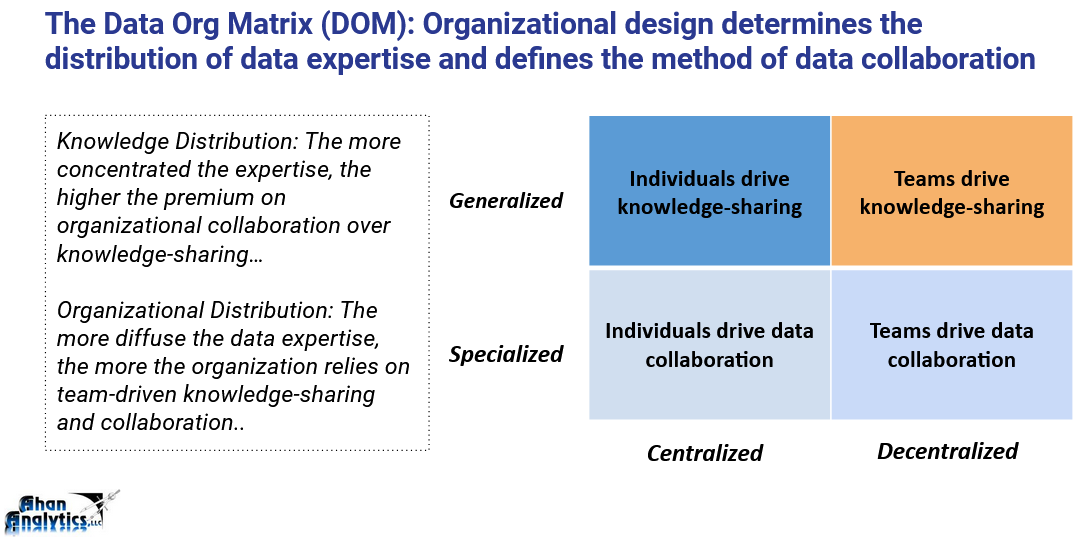
Whether embedded in a centralized or decentralized organization, data professionals, data analysts in particular, must act as system designers across the entire data-to-decision process. Where they lack the expertise in a part of the system, they must collaborate in a cross-functional way with the relevant domain experts.
Conclusion: Supporting Evolution for Data Analysts
The data analyst is not a back-office technician. Today’s analyst must design for clarity, communicate for alignment, and build for use. Curation, communication, and product thinking are core skills for the job. I am encouraged to see a BI tool like Omni building specifically for this job, a tool that also supports and enables the cross-functional fluency and systems-level thinking that defines today’s analytics requirements. For better insights, businesses must recognize what Zima does: the future of analytics depends on investing in the full scope of the data analyst’s evolving role.